
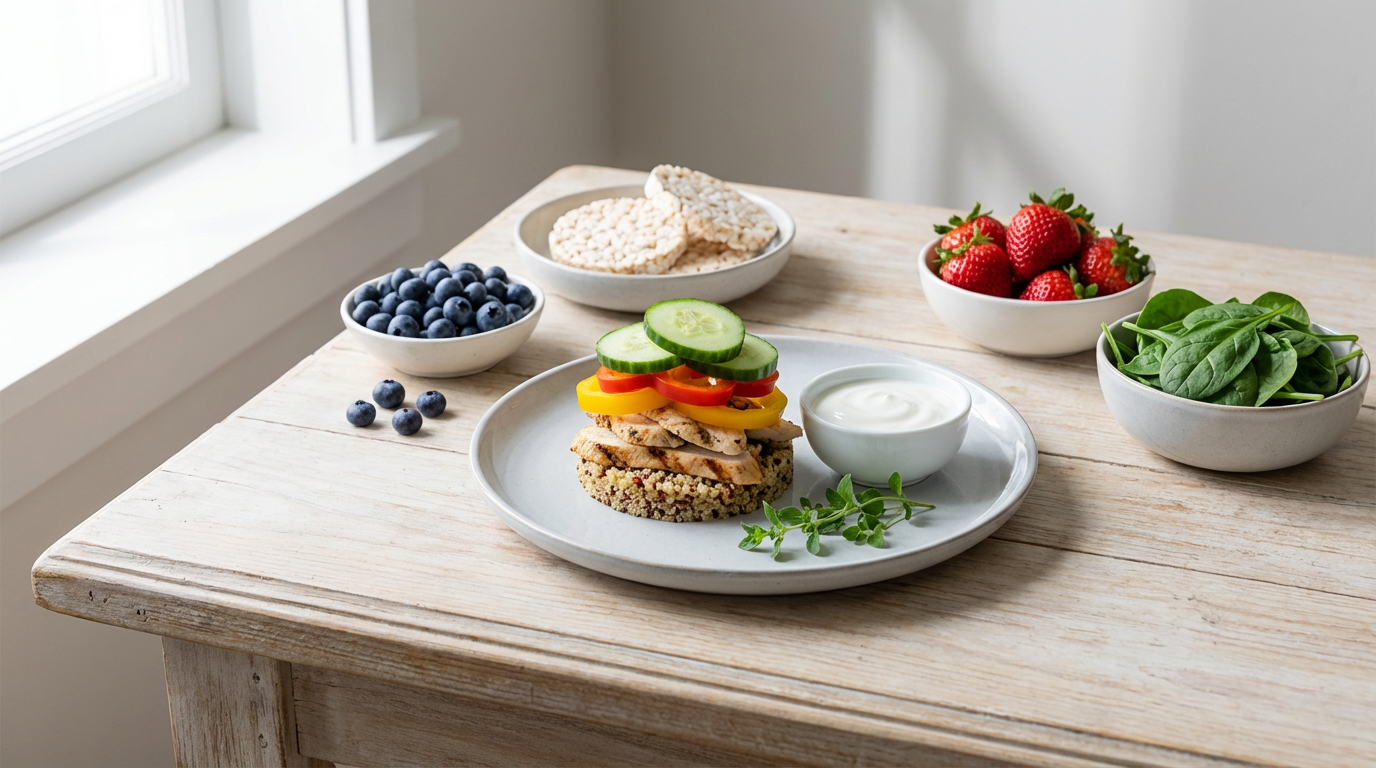
It is one of the most frustrating moments in the life of anyone managing IBS.
You have been perfect. You have followed every rule. You checked your app, and every single ingredient in your lunch was given a "Green Light" safe rating.
Yet, two hours later, you are unbuttoning your jeans, dealing with painful cramping, and looking like you're six months pregnant. What went wrong?
The answer is likely the most complex part of the low FODMAP journey: FODMAP stacking.
Here in 2026, we have incredible technology to help us manage digestive health, but even the best apps can’t always predict how your specific body calculates the total load of fermentable carbohydrates in a specific meal. If you have been strictly adhering to the diet but haven't seen the symptom relief you were promised, stacking is almost certainly the culprit.
FODMAP stacking occurs when you eat multiple foods that are "low FODMAP" individually, but when eaten together in a single sitting, the total amount of fermentable sugars tips over the edge into "high FODMAP" territory. It’s a math problem happening inside your gut.
In this guide, we are going to demystify the math. We’ll look at how to structure your plates to avoid this trap, how to use tools like our Symptom Tracker to pinpoint your personal limits, and how to finally get the relief you deserve.
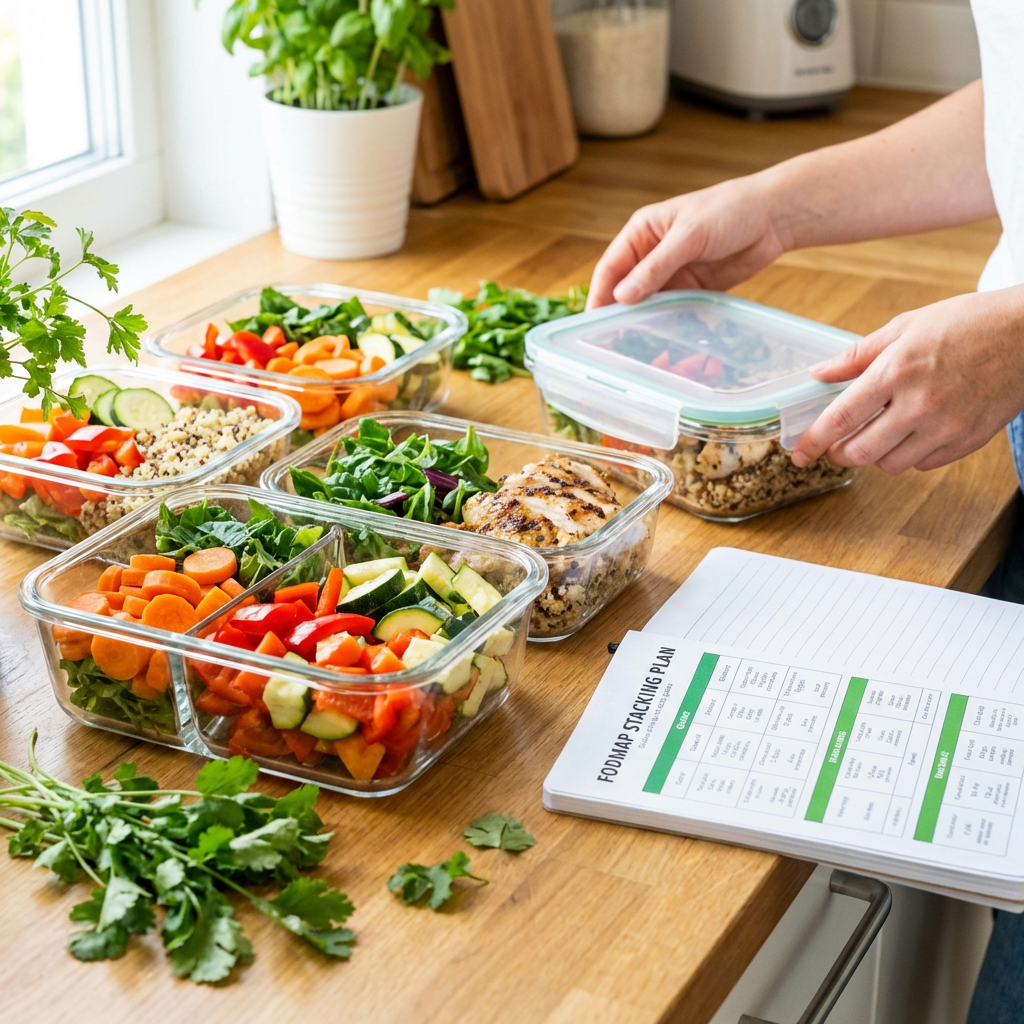
Evidence-Based Information: This guide is informed by research from the Monash University FODMAP Program, the leading authority on FODMAP research. Always consult with a registered dietitian for personalized advice.
What Is FODMAP Stacking? (The Bucket Effect)
To understand FODMAP stacking, you have to stop looking at foods as simply "Safe" or "Unsafe" and start thinking about them in terms of volume.
Imagine your gut is a bucket. Everyone with IBS has a bucket of a different size.
- The Water: FODMAPs (fermentable carbohydrates) are the water.
- The Leak: Your digestion is the hole at the bottom that slowly drains the water.
If you pour a small glass of water (a low FODMAP serving of almonds) into the bucket, it drains fine. No overflow. If you add another small glass (a low FODMAP serving of green beans), it might still be okay.
However, if you pour in almonds, green beans, and a serving of sweet potato all at once, you might fill the bucket faster than it can drain. The bucket overflows. That overflow is your bloating, gas, and pain.
According to the experts at Monash University, which developed the diet, many "Green Light" foods actually contain trace amounts of FODMAPs. Eating 3 or 4 of these foods together creates a cumulative effect that triggers symptoms.
The Golden Rule: Stacking by FODMAP Group
This is where most people get confused. You generally don't need to worry about stacking different types of FODMAPs (unless you are extremely sensitive). You need to worry about stacking the same type.
As you likely know from reading our FODMAP Diet Guides, the acronym stands for Fermentable Oligosaccharides, Disaccharides, Monosaccharides, and Polyols.
Here is the critical strategy:
If you have a meal containing a moderate amount of Fructans (like 1 slice of spelt bread), you want to avoid adding another heavy Fructan food (like zucchini) to that same meal. However, you could safely add a food high in Lactose (like cheddar cheese) because that goes into a different "bucket."
How to Identify the Groups
Before you build your plate, you need to know what you are dealing with. Use our FODMAP Food Checker Tool to look up ingredients. Don't just look for "Green" or "Red." Look at the specific sub-group symbols.
- Oligos: (Fructans & GOS) – Found in wheat, onions, garlic, legumes.
- Fructose: Found in honey, apples, high fructose corn syrup.
- Polyols: (Sorbitol & Mannitol) – Found in stone fruits, mushrooms, cauliflower.
- Lactose: Found in dairy.
5 Strategies to Avoid FODMAP Stacking
Avoiding FODMAP stacking doesn't mean you have to eat boring, single-ingredient meals. It just requires better architectural planning of your plate. Here is how to master it.
1. Space Your Meals Correctly
Timing is everything. It takes time for food to move through the digestive tract. If you eat a meal high in Oligos at 12:00 PM, and then snack on more Oligos at 1:30 PM, you are stacking those loads.
The Fix: Aim to leave 3 to 4 hours between meals. This allows the "bucket" to drain, resetting your threshold for the next meal. If you are grazing all day, you are constantly topping up the fermentation tank.
2. Balance Green vs. Trace Foods
Not all low FODMAP foods are created equal.
- "Eat Freely" Foods: There are foods containing no detectable FODMAPs (e.g., protein like chicken, eggs, tofu; fats like olive oil; veggies like carrots and regular potatoes). You cannot stack these. You can eat them until you are full.
- "Limit" Foods: These are safe servings of higher FODMAP foods (e.g., canned chickpeas, broccoli heads, almonds). These are the ones where FODMAP stacking occurs.
The Strategy: Build the bulk of your meal with "Eat Freely" foods, and pick only one or two "Limit" foods to garnish or flavor the meal.
3. Watch the Fruit Intake
Fruit is a common tripping point. You might have a safe serving of blueberries (safe) and a safe serving of raspberries (safe). But if you put them both in a smoothie, you have likely exceeded your fructose load for one sitting.
We have a great collection of Snack Recipes that are designed to keep fruit portions strictly within safe limits to prevent this exact issue.
4. Utilize the Traffic Light System
When using the Monash app or our checker tools, pay attention to the serving sizes that turn the light yellow or red.
If a food serves as a "Green" at 75g, but turns "Yellow" at 100g, that means the margin for error is small. That food is a high risk for stacking. If a food is Green at 75g and remains Green at 250g, it is a low risk for stacking.
5. Substitution is Key
If you have a recipe that calls for two high-Fructan vegetables, use our Ingredient Swap Finder to switch one of them out. For example, swap the zucchini (fructan risk) for carrots (no undetected FODMAPs) to balance the meal.
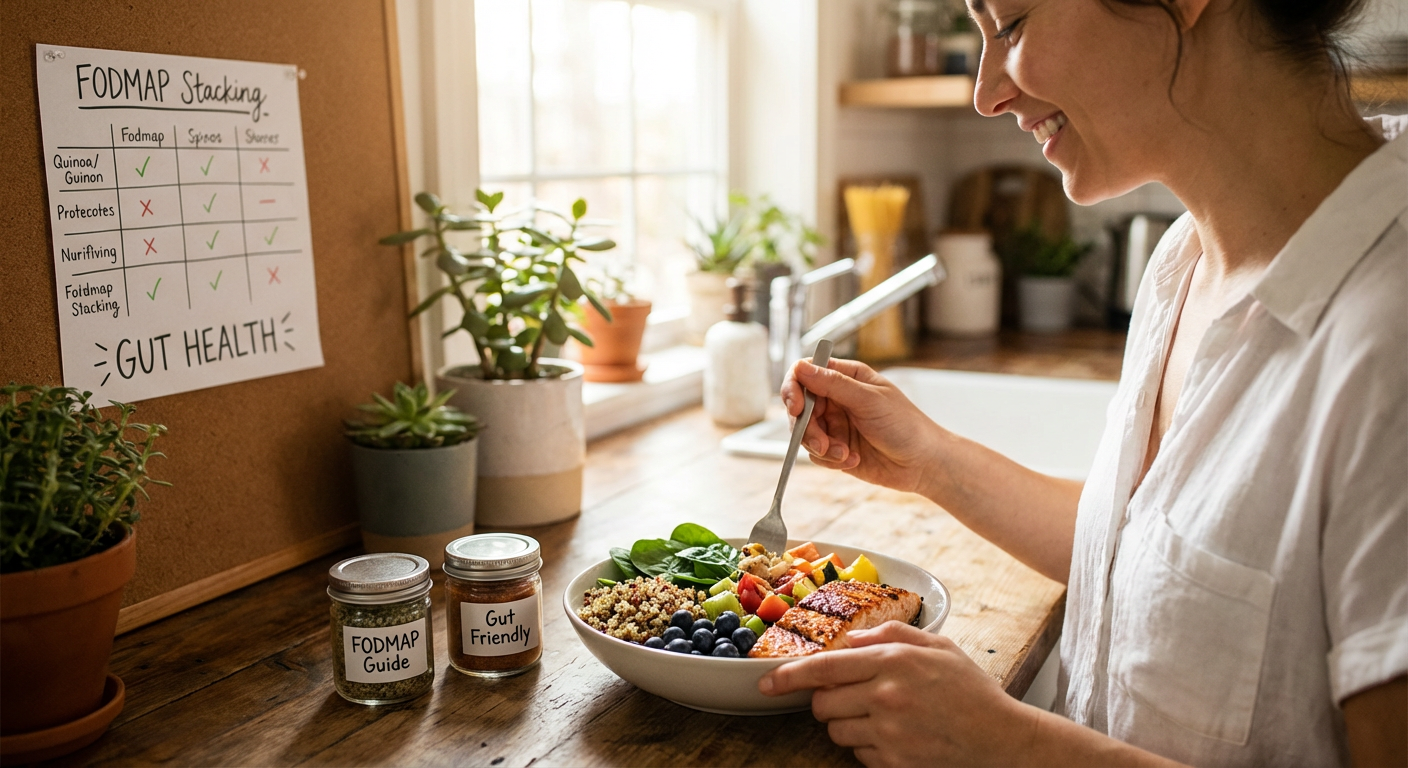
Real-Life Examples: The "Stacking" Salad vs. The Safe Salad
Let's look at a practical example of how FODMAP stacking sneaks into a healthy lunch.
❌ The Stacking Salad (Disaster Waiting to Happen)
- Base: Spinach (Safe)
- Topping 1: 1/2 cup canned Chickpeas (Safe serving, but contains GOS)
- Topping 2: 10 Almonds (Safe serving, but contains GOS)
- Dressing: Tahini based (Safe serving, but contains GOS)
The Verdict: While every ingredient here resembles a safe portion individually, they are all GOS heavy. Combining chickpeas, almonds, and tahini in one bowl will likely trigger a reaction.
✅ The Anti-Stack Salads (Safe)
- Base: Spinach (Safe)
- Topping 1: grilled Chicken (Protein - No FODMAPs)
- Topping 2: 1/2 cup Canned Lentils (GOS)
- Topping 3: Walnuts (Safe serving - mostly Fructan/low trace)
- Dressing: Olive oil and Lemon juice (No FODMAPs)
The Verdict: We reduced the GOS load by removing the almonds and tahini, replacing them with walnuts (different group) and chicken/oil (no FODMAPs).
If you need more inspiration for safe combinations, browse our Dinner Recipes or Lunch Ideas where we have already done the math for you.
4 Safe Meal Ideas (Stack-Free)
Here are four meal concepts that naturally avoid FODMAP stacking by diversifying the ingredient groups.
1. The Safe Breakfast Scramble
Check out our Breakfast Recipes for the full version, but the concept is strict:
- Eggs (No FODMAPs)
- Sourdough Bread (Fructan - limit 2 slices)
- Cheddar Cheese (Lactose - insignificant amount)
- Spinach (No FODMAPs)
- Why it works: The only FODMAP source here is the bread. No competition in the gut.
2. Rice & Meat Bowl
- White Rice (No FODMAPs)
- Salmon (No FODMAPs)
- Carrots & Cucumber (No FODMAPs)
- Soy Sauce (Low FODMAP)
- Why it works: This is practically a "zero FODMAP" meal, meaning you can eat a larger volume without any risk of stacking.
3. The Separated Snack Plate
- Rice Crackers (No FODMAPs)
- Hard Cheese (Lactose - Low)
- Macadamia Nuts (Safe nuts)
- Why it works: Macadamias are lower in fermentable carbs than cashews or pistachios, and rice crackers provide crunch without the wheat load.
4. IBS-Friendly Pasta Night
Using our Recipe Converter, you can adapt pasta night:
- Gluten-Free Pasta (Rice/Corn based - No FODMAPs)
- Tomato Sauce (Make sure no onion/garlic - Fructose safe in 1/2 cup)
- Lean Ground Beef (No FODMAPs)
- Why it works: The FODMAP load is restricted entirely to the tomatoes.
Common Stacking Mistakes to Avoid
Even veterans of the diet fall into these traps.
- Trusting "Gluten-Free" blindly: Many GF products use bean flours or apple juice concentrate. Just because it is GF does not mean it is stack-free.
- Ignoring Condiments: A tablespoon of Ketchup (Fructans) plus a pickle (Fructans) plus a spice rub (possible onion powder) creates a sauce stack that ruins a safe burger.
- The "Just a Little Bit" Mentality: "I'll just have a little bit of avocado and a little bit of broccoli." If they both contain Sorbitol, that "little bit" becomes a "lot."
- Not Reading Labels on Supplements: Many fiber supplements or probiotics contain inulin (High Fructan/Oligos). Taking this with a meal can cause immediate stacking.
For a deeper dive on medical management, the NIDDK IBS Information page is an excellent resource for understanding how diet interacts with gut motility.
Helpful Tools & Resources
Make your low FODMAP journey easier with these free tools:
- FODMAP Food Checker — Instantly check if a food is low FODMAP
- Recipe Converter — Convert any recipe to low FODMAP
- Ingredient Swap Finder — Find safe substitutes for high FODMAP ingredients
- Browse All Low FODMAP Recipes — Hundreds of gut-friendly recipes
FAQ: People Also Ask
How long should I wait between meals to avoid FODMAP stacking?
Ideally, you should wait 3 to 4 hours between meals. This allows the migrating motor complex (MMC) in your gut to sweep undigested food and bacteria through the digestive tract, resetting your FODMAP threshold.
Can I stack foods from different FODMAP groups?
Generally, yes. Most people can handle a small amount of Sorbitol and a small amount of Fructans in the same meal better than they can handle two sources of Sorbitol. However, look at your IBS-Friendly Recipes to see examples of how we balance total load, as very sensitive individuals may react to the total volume of fermentation regardless of the type.
Does everyone need to worry about stacking?
Not necessarily. During the elimination phase, you should be strict about stacking. However, once you move to the reintroduction phase, you might find your "bucket" is larger than you thought. Stacking is mostly a concern for those who are strictly following the diet but still having symptoms.
Are there any foods that never stack?
Yes! Proteins (meat, fish, eggs), fats (oils, butter), and specific vegetables like carrots, red peppers, and potatoes contain no detectable FODMAPs. You can eat these without worrying about the math.
Does cooking reduce the FODMAP content so I can stack more?
For the most part, no. Cooking does not break down FODMAP sugars enough to make them safe. However, leaching (canned lentils or rinsing chickpeas) does lower the GOS content significantly.
Conclusion: Don't Let the Math Scare You
Learning about FODMAP stacking can feel overwhelming at first. It feels like you need a calculator just to eat lunch. But take a deep breath.
You do not need to be perfect every single meal. The goal is to understand the principles so that when you do have a flare-up, you can look back and say, "Ah, I ate almonds and hummus together. That was a GOS stack," rather than feeling betrayed by your body.
Start simple. Spread your meals out. rely on those "Eat Freely" foods to bulk up your plate, and use our tools to check your combinations.
Ready to simplify your cooking? Head over to our Low FODMAP Recipes section now to find hundreds of meals that have already been optimized just for you. You've got this!


