
Before You Start: Why Bottled Dressing Wrecks IBS
Turn over almost any supermarket vinaigrette and you will find onion powder, garlic powder, "natural flavours", honey or inulin/chicory root fibre. These are concentrated fructans and fructose — the two FODMAP groups that most reliably trigger bloating, wind and cramping. A two-tablespoon serving of a garlic-and-onion dressing can undo an otherwise perfect low FODMAP salad. Making your own removes the guesswork completely. If you are ever unsure about a single ingredient, run it through the FODMAP Food Checker before it goes in the jar.
Equipment
A 250 ml (8 oz) glass jar with a tight lid is all you need. Shaking in a jar emulsifies better than stirring in a bowl, and you store the dressing in the same container. A small whisk and bowl also work; a mini blender is only needed for the creamy and tahini versions if you want them silky smooth.
Method: The Master Base Vinaigrette
Step 1 — Measure the acid first (1 minute). Add the red wine vinegar and lemon juice to your jar. Starting with the acid rather than the oil means the salt and mustard dissolve properly instead of sitting in a slick on top. Cold acid straight from the fridge is fine.
Step 2 — Dissolve the seasoning (1 minute). Add the sea salt, black pepper, Dijon mustard and maple syrup. Screw the lid on and shake hard for 15 seconds. The mixture should look slightly cloudy and thickened — that is the mustard doing its job as an emulsifier. This is the single most important step for a dressing that does not split.
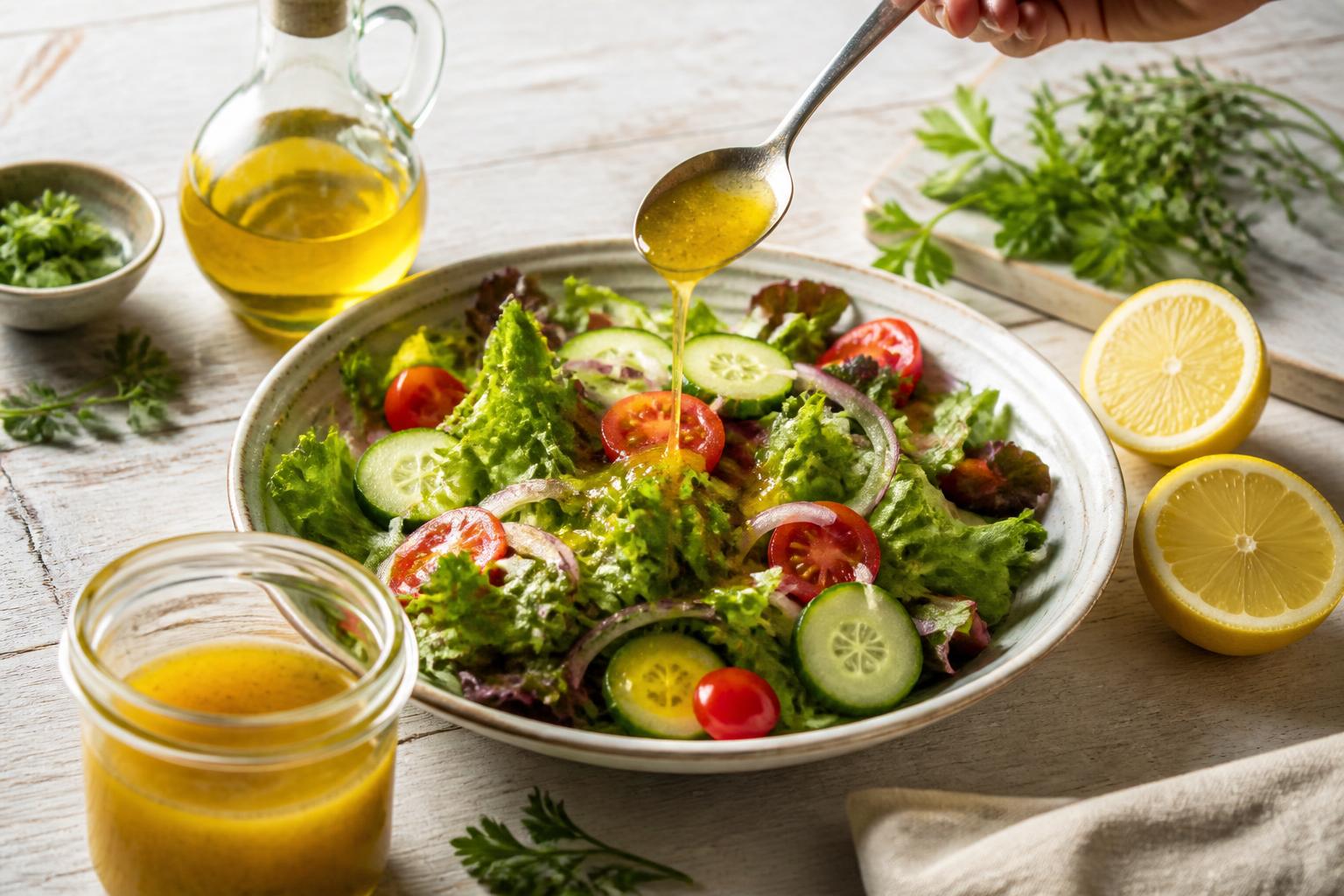
Step 3 — Add the garlic-infused oil slowly (2 minutes). Pour in the garlic-infused olive oil in two or three additions, shaking hard for 10–15 seconds after each. Adding it gradually gives you a stable emulsion; dumping it in at once gives you an oily layer that separates within a minute. The finished dressing should look pale gold, opaque and glossy, and coat the inside of the jar rather than running straight off.
Step 4 — Check the flavour balance (1 minute). Dip a lettuce leaf, not a spoon — dressing always tastes sharper on its own than it does on a salad. Too sharp? Add another 1/2 teaspoon maple syrup. Too flat? Another pinch of salt. Too thick and clingy? A teaspoon of cold water, not more oil, which would dull it.
Step 5 — Stir in the fresh herbs (1 minute). Add the chives, parsley and dried oregano last so they stay bright green and do not bruise during the vigorous shaking. Use only the green tips of chives — the white bulb end is higher in fructans. Give the jar one gentle inversion to distribute.
Step 6 — Rest before serving (10 minutes). Let the dressing sit at room temperature for 10 minutes. The dried oregano rehydrates, the herbs release their oils, and the flavour deepens noticeably. Shake once more just before pouring.
Variation 1: Creamy Herb Ranch-Style
Make the base vinaigrette, then whisk in 3 tablespoons lactose-free plain yogurt and 1 tablespoon chopped fresh dill. Reduce the vinegar to 1 tablespoon because the yogurt adds its own tang. This is the closest thing to a ranch dressing you can safely eat on the elimination phase — excellent on wedge salads, as a dip for carrot sticks, or drizzled over roasted potatoes. Because it contains dairy, keep it refrigerated and use within 4 days.
Variation 2: Lemon-Tahini
Whisk 2 tablespoons hulled tahini with 2 tablespoons cold water until smooth (it will seize and look grainy first — keep going, it comes back together), then stir into the base with an extra tablespoon of lemon juice. Tahini is low FODMAP at 2 tablespoons per serve, so keep to about 1 tablespoon of finished dressing per person if you are highly sensitive. Perfect over roasted vegetables, grain bowls and grilled chicken. Use the Portion Calculator if you are stacking it with other moderate-FODMAP ingredients in the same meal.
Variation 3: Balsamic-Maple
Swap the red wine vinegar for 2 tablespoons balsamic vinegar and increase the maple syrup to 2 teaspoons. Balsamic is low FODMAP at 1 tablespoon per serve, which this recipe respects across four servings. Deep, slightly sweet and ideal on rocket, strawberries, walnuts and hard cheese.
Variation 4: Zesty Italian
Add 1/2 teaspoon dried basil, 1/4 teaspoon dried thyme and 1 teaspoon finely grated hard parmesan to the base. Aged hard cheeses are virtually lactose free, so parmesan is safe in these quantities. Great as a marinade for chicken thighs as well as a dressing.
Chef Tips and Troubleshooting
- It separated in the fridge. Completely normal — olive oil solidifies when cold. Leave the jar on the counter for 10 minutes and shake hard; it re-emulsifies.
- It tastes bitter. Over-shaking a strong extra virgin olive oil can turn it bitter. Use a milder infused oil, or shake in shorter bursts.
- It is not garlicky enough. Use a good quality garlic-infused oil and add the optional 1/4 teaspoon asafoetida. Never add fresh garlic, garlic powder or garlic paste — the fructans are water-soluble and will end up in your dressing.
- You want it thicker for a dip. Add 1 extra teaspoon Dijon, or use the creamy herb version.
- You want a bigger batch. The base scales perfectly: keep the ratio of 3 parts oil to 1 part acid.
Storage
Store in the sealed jar in the fridge. The base vinaigrette, balsamic-maple and zesty Italian versions keep for 7 days; the lemon-tahini keeps 5 days; the creamy herb keeps 4 days. Do not freeze — the emulsion breaks permanently. Always shake before each use and never dip a used utensil back into the jar.
Serving Ideas
Pour it over a simple salad of cos lettuce, cucumber, carrot, cherry tomatoes and roasted pumpkin. It also works as a quick marinade for chicken or firm tofu, a drizzle for grain bowls made with quinoa or rice, and a finishing sauce for grilled fish. For full meals to pair it with, browse our low FODMAP lunch recipes and low FODMAP dinner recipes, or explore the full low FODMAP recipe collection.
Need to convert a family dressing recipe you already love? Paste it into the Recipe Converter, and find safe replacements for anything flagged with the Ingredient Swap Finder. If salads have been triggering symptoms for you, log what you ate in the Symptom Tracker so you can separate the dressing from the vegetables as the real cause. Newer to the diet? Start with our FODMAP diet guides.